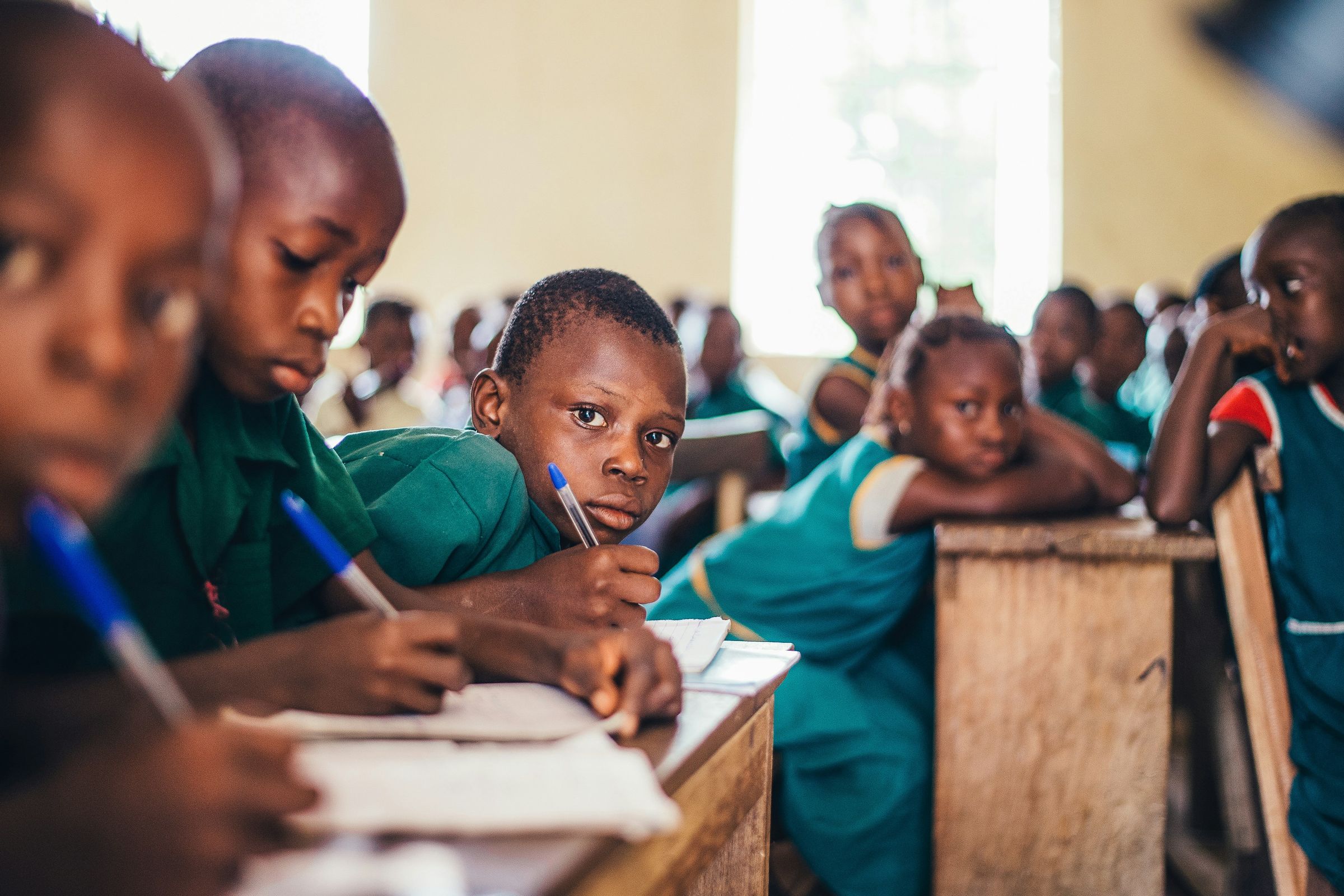

Executive summary
Nigeria has made significant progress in expanding access to education. Yet youth unemployment remains a persistent concern, with 6.5% of young people aged 15 to 24 unemployed in Q2 2024, while 12.5% were not in employment, education or training (NEET) (National Bureau of Statistics (NBS), Nigeria Labour Force Survey, Q2 2024). These outcomes highlight an important question: does increased enrollment translate into the knowledge, skills and capabilities young people need to participate productively in the economy?
Evidence from an original survey of more than 100 schools in Nigeria, including 70 student respondents and discussions with teachers and school administrators, points to persistent weaknesses in the learning environment. Among the 20 public schools covered, 19 (95%) reported significant infrastructural challenges. Teacher accounts also indicate that school attendance declines sharply during periods of peak agricultural activity, with reported attendance reductions reaching up to 90% in some communities between March and August.
These findings point to an Access-Quality Disconnect: children may be enrolled in school without consistently receiving the quality, continuity and support required to acquire productive skills.
Nigeria’s next phase of education reform should therefore move beyond measuring whether children enter and remain in school. Policy must increasingly focus on whether students are learning, developing relevant skills and building the capabilities needed to contribute productively to the economy.
Policy message: Access is the foundation. Quality determines the return. Nigeria should shift from measuring educational progress primarily through enrollment, attendance and completion toward a broader pathway: access, sustained participation, learning, skills, employability and productivity.
Key evidence
- 95% of the public schools surveyed reported significant infrastructural challenges.
- Attendance declines of up to 90% were reported during peak agricultural periods in some communities.
- 70 students participated in the study, alongside discussions with teachers and school administrators.
The policy problem: are Nigerian students in school but not learning?
Over the years, expanding access to education has been central to education policy across Nigeria and Africa. Enrollment, attendance and completion remain important measures of educational progress. But these indicators do not tell us whether students are actually learning.
A child can be formally enrolled in school while experiencing inadequate learning facilities, shortages of instructional materials, irregular attendance, limited exposure to practical learning, disrupted curriculum delivery and insufficient support for developing relevant skills.
Why does this matter beyond education?
The quality of education determines the quality of human capital available to the economy. With approximately 63% of Nigeria’s population under 25 years of age, the country’s economic future depends heavily on the capabilities of its workforce (UNFPA Nigeria, Country Programme Document, 2023). Yet it records only about five learning-adjusted years of schooling, a reminder that time spent in school does not automatically translate into equivalent learning (World Bank, Nigeria Country Growth and Jobs Report and Human Capital Index). When students leave school without strong foundational, technical and problem-solving skills, the consequences extend beyond the classroom, affecting employment, productivity and capacity for economic transformation.
Education should therefore be viewed not only as a social sector priority, but also as an investment in the capabilities required for a more productive economy.
When access does not equal learning
Enrollment in school is only one part of the education process. Human capital is developed not just through being present in school, but through consistent exposure to quality teaching, structured learning time, assessments and opportunities to build practical skills. This means that even when students are officially enrolled, gaps in attendance, instruction or learning conditions can prevent them from fully benefiting from the education system. A student may be enrolled in school but still miss:
- Lessons and curriculum content.
- Assessments and examinations.
- Practical learning opportunities.
- Opportunities to develop relevant skills.
The Access-Quality Disconnect
Being enrolled in school does not equate to benefiting from schooling. Students may move through the education system without consistently receiving the instructional continuity and practical opportunities required to develop productive capabilities. As a result, years of schooling may not translate into the competencies needed for meaningful participation in the economy.
The question is no longer simply how many children are entering school. It is whether the education system is turning access into skills and productive capabilities.
The evidence: what is happening inside Nigerian schools?
Evidence from an original survey of over 100 schools across Nigeria, supplemented by responses from 70 students and discussions with teachers and school administrators, reveals important gaps between educational access and the conditions required for sustained learning. Two findings stand out: infrastructure is a major constraint, and participation in schooling is disrupted by students’ economic and household responsibilities.
Infrastructure as a major constraint
Nineteen of the 20 public schools surveyed (95%) reported significant infrastructural challenges. Reported challenges included inadequate classroom facilities, limited learning materials and insufficient educational resources. These are not simply physical shortcomings. They directly shape the environment in which teaching and learning take place. When classrooms and instructional materials are inadequate, students have fewer opportunities to engage effectively with teaching.
The finding points to a critical policy concern: expanding access to schools without ensuring that those schools provide adequate conditions for learning risks increasing enrollment without achieving equivalent improvements in educational quality.
Enrollment does not guarantee sustained participation
Teacher discussions revealed that attendance can be significantly affected in rural communities during periods of peak agricultural activity. The most affected groups included students in JSS3 and SS1 to SS3, with the greatest reported absenteeism occurring between March and August, during the peak agricultural period. In some communities, teachers reported attendance declines of up to 90% during these periods.
The cost of interrupted learning
Frequent absenteeism does not only reduce the number of days students spend in school. It also disrupts the continuity of learning that is essential for understanding and skill development. When students are repeatedly absent, they fall out of step with lesson progression, making it harder to fully grasp new concepts when they return. Over time, these gaps accumulate and eventually weaken overall academic performance. Students who are repeatedly absent miss:
- Classroom instruction and key curriculum topics.
- The progression of knowledge and skills.
- Tests and formal examinations.
- Hands-on and practical learning experiences.
The evidence points to a simple progression
Enrollment does not imply participation. Participation does not imply learning. Schooling does not automatically produce productive skills.
The evidence suggests that educational access should not be treated as the end point of education policy. Enrollment creates the opportunity to learn, sustained participation creates the conditions for learning, and meaningful learning builds the knowledge and skills that ultimately contribute to productive employment. When any of these links is weakened, the developmental value of education is reduced.
This means that measuring how many children enter or complete school is only the beginning. The more important policy question is whether Nigeria’s education system is converting access into learning, learning into skills and skills into productive capabilities.
Source: Author’s original survey and school-level discussions; infrastructure finding based on 20 public schools.
Why it matters: education is an economic investment when it builds productive capabilities
Education is an investment in human capital. The value of that investment depends not only on how many years students spend in school, but on the knowledge, competencies and adaptability they acquire.
When learning is consistently interrupted or constrained by poor educational environments, Nigeria risks producing educational credentials without equivalent improvements in productivity. The consequences extend beyond the classroom, affecting how young people transition into employment, how workers contribute to productivity and how effectively the economy can diversify and transform. The chain runs from quality education to relevant knowledge and skills, to employability, to labor productivity, to economic diversification and, finally, to structural transformation.
Four economic consequences
Labor productivity. Workers with stronger foundational and technical competencies are better positioned to adopt technologies and perform complex tasks.
Employability. Students who acquire relevant knowledge and skills are better prepared to transition from education into employment.
Economic diversification. Higher-productivity manufacturing and modern services require workers with appropriate cognitive, technical and adaptive skills.
Structural transformation. Moving labor from low-productivity activities toward higher-productivity sectors depends partly on the education system’s capacity to produce an appropriately skilled workforce.
The bigger development question
Improving educational quality should not be treated simply as a social-sector objective. It is an economic development strategy. If education is expected to contribute to employment, productivity and structural transformation, then policy must pay greater attention to what students learn and what capabilities they leave school with, not only whether they were enrolled.
The policy gap: is Nigeria measuring the right outcomes?
Nigeria’s existing education indicators remain essential. Enrollment, attendance and completion tell policymakers whether children are entering, participating in and progressing through the education system. The upper-secondary completion rate stood at only 63.6% in 2024, meaning more than one-third of the relevant cohort did not complete upper secondary education on time (UNESCO Institute for Statistics (UIS), World Education Statistics 2024). More importantly, completion alone does not reveal whether students have acquired the knowledge and competencies needed for productive employment.
These indicators are therefore not sufficient to determine whether education is producing meaningful learning or building the capabilities required for productive employment. The policy challenge is not to abandon access measures, but to expand the definition of educational success from simply counting participation and completion to measuring what students actually learn and can do.
What we currently track runs from enrollment to attendance to completion. These indicators do not tell enough about what students actually learn or what competencies they develop. Educational progress should capture the full chain: access, sustained participation, learning, skills, employability and productivity.
From counting participation to measuring capability
A stronger education monitoring framework would ask not only whether children are enrolled and completing school, but whether they are acquiring the knowledge, competencies and practical skills needed to participate productively in the economy. This would allow policymakers to distinguish between educational expansion and effective human capital formation. Educational progress should include measurable outcomes in:
- Foundational literacy and numeracy.
- Digital competence.
- Problem-solving.
- Practical and technical skills.
- Competencies relevant to labor-market participation.
Educational policy needs to shift from asking “How many children are in school?” to asking “What are children learning, what capabilities are they developing, and how will those capabilities contribute to the future economy?”
Policy recommendations: what should we do differently?
Nigeria does not need to choose between expanding access and improving quality. The priority should be to ensure that investments in access translate into sustained participation, meaningful learning and the development of productive skills. The following policy actions can help close the Access-Quality Gap and strengthen the contribution of education to human capital development.
Measure learning, not just enrollment
Education monitoring frameworks should place greater emphasis on measurable learning outcomes alongside enrollment, attendance and completion. Monitoring should capture foundational literacy and numeracy, digital competence, problem-solving, practical skills and competencies relevant to labor-market participation.
Policy priority: Make learning outcomes a central measure of educational progress.
Protect continuity of learning
In communities where agricultural and household economic activities significantly disrupt attendance, education authorities should develop context-specific mechanisms to protect learning continuity. Possible responses include:
- Flexible learning arrangements.
- Targeted catch-up programs.
- Community-based learning support.
- Engagement with parents and community leaders.
- Mechanisms for recovering missed instructional time.
Policy priority: Move beyond recording attendance to ensuring that students do not permanently lose learning time.
Strengthen teacher capacity
Infrastructure alone cannot improve learning outcomes. Investment should also strengthen teachers’ ability to deliver effective and continuous instruction. Priority areas should include continuous professional development, instructional support, appropriate teaching materials, classroom management, and the monitoring and improvement of teaching effectiveness.
Policy priority: Treat teacher capacity as a core component of education quality.
Link education to economic planning
Education policy should be linked more directly to Nigeria’s employment, industrialization and economic diversification strategies. The central policy question should shift from “How many children are we putting through school?” to “What capabilities are we building, and how will those capabilities contribute to Nigeria’s future economy?”
Policy priority: Align education outcomes with the skills and capabilities required for Nigeria’s economic transformation.
Target infrastructure where need is greatest
Government investment should prioritize schools facing the greatest deficiencies in learning materials, connectivity and digital resources. Resource allocation should respond to differences in educational need rather than relying solely on uniform spending approaches.
Policy priority: Direct resources toward schools where inadequate learning conditions are most severe.
The policy shift: from getting children into school to building the capabilities Nigeria needs
Nigeria does not need to choose between access and quality. With approximately 63% of Nigeria’s population under the age of 25, the quality of today’s education system will shape the capabilities of a generation that will define the country’s future workforce and economy (UNFPA Nigeria, Country Programme Document, 2023). Access remains the foundation of an effective education system. But the developmental return on that access depends on whether students experience meaningful learning, acquire relevant skills and develop the capabilities to participate productively in the economy.
Closing the Access-Quality Gap therefore requires a shift from simply expanding access to ensuring that access produces learning. The ultimate goal is simple: more children in school should mean more children learning effectively and, ultimately, more young people equipped to contribute productively to the economy.
Five priorities for policy action
- Measure learning. Track what students actually know and can do.
- Target infrastructure. Prioritize schools with the greatest needs.
- Protect learning time. Address seasonal and economic barriers to attendance.
- Strengthen teachers. Invest in teaching quality and instructional support.
- Link education to the economy. Build capabilities aligned with employment and productivity.
What the shift can achieve
Closing the Access-Quality Gap would strengthen the contribution of education to human capital development, by building stronger foundational, technical and adaptive capabilities; to employment, by improving young people’s preparedness for productive work; to productivity, by strengthening the capabilities workers need to perform effectively and adopt new technologies; and to long-term economic transformation, by supporting the movement toward higher-productivity sectors and a more diversified economy.
Nigeria’s education challenge is no longer only about getting children into classrooms. It is about ensuring that classrooms produce learning, skills and capabilities that can transform lives and the economy.
Evidence base
This policy brief draws on original school-level evidence from more than 100 schools across Nigeria, including 70 student respondents and discussions with teachers and school administrators. The infrastructure finding is based specifically on 20 public schools within the broader evidence base. The study examined school infrastructure, learning resources, attendance patterns and disruptions to instructional continuity.
The findings are complemented by evidence from the National Bureau of Statistics (NBS), UNESCO Institute for Statistics (UIS), World Bank, UNFPA and the United Nations Economic Commission for Africa (UNECA), alongside relevant academic research on youth employment, education outcomes, human capital and economic transformation.
Selected sources: National Bureau of Statistics (NBS), Nigeria Labour Force Survey, Q2 2024. UNESCO Institute for Statistics (UIS), World Education Statistics 2024. World Bank, Nigeria Country Growth and Jobs Report and Human Capital Index data. UNFPA Nigeria, Country Programme Document for Nigeria, 2023. United Nations Economic Commission for Africa (UNECA). Author’s original school-level survey and stakeholder discussions.



Comments
No comments yet.